Sunday, November 21, 2010

Late Roman/Early Christian


Commodus as Hercules c. 191-192

   The bust of Commodus as Hercules is beautifully sculpted—with a great likeness in the elongated face and large eyelids to his father, Marcus Aurelius, and immense detail in his curly hair and beard. However, dressed in Herculean garb and proclaiming himself as the incarnation of the god Jupiter was perhaps going out of style in his time. The Equestrian statue of Marcus Aurelius shows greater class and a more humbled form of propaganda. Commodus’ somewhat ridiculous bust reveals his vanity and distance from reality. While the classical era welcomed emperors and kings claiming divinity, the second century CE required a literally “down to earth” leader—someone in touch with the reality of the hardships people faced.

The Good Shepherd: Lunette over the entrance, Oratory of Galla Placidia c. 425-426

   The Oratory of Galla Placidia is “one of the earliest surviving Christian structures in Ravenna” (Stokstad 232). The interior of the oratory, or small chapel, is covered in glass mosaics depicting biblical figures. “The Good Shepherd” shows Jesus as a grown man with a cross instead of a shepherd staff as well as a halo over his head—signifying his “imperial majesty” (233). The mosaic was meant to glorify Jesus, as Christianity had recently been declared the state religion. In many of the earlier depictions of Christ, he was beardless with a shepherd staff. Here he is still among his sheep, but is portrayed in his post-resurrection attire.   


Leading up to the Christian era, Pharaohs, Kings, and Emperors have intermittently claimed to be semi-divine or divine and have been portrayed as such. A rather embarrassing example of this convention is the bust of Commodus as Hercules, as I have discussed above. This bust is an example of this old mentality. After the reign of Constantine and the accepting of Christianity, humans portrayed as divine incarnations were considered blasphemy. From the late Roman Empire and into the early Christian era, there is a great increase in church construction. In terms of the architecture of these churches, there isn’t much change from the basilicas of the Roman Empire with their columns and clerestory windows. The main difference seems to be in ideology—from polytheism to the monotheism of Christianity. 

Friday, November 5, 2010

Centaus and Lapiths


In class we have discussed the evolution of Greek Art—from the Orientalizing and Geometric periods to the Classical style of Periclean Athens during the construction of the Parthenon. Perhaps the best way to study this change is to compare two works from the two different periods portraying the same subject. The mythological battle of the Lapiths versus the Centaurs was portrayed in Greek sculpture in both the Archaic and the Classical period and most likely persisted throughout the Ancient Greek era. The people of Athens prided themselves on being a powerful military force in the face of barbarism. This ideology is embodied in sculpture, the numerous reliefs on the metopes of the Parthenon as well as the eastern and western Pedimental sculptures.
            The bronze sculpture of the Man and Centaur, constructed ca. 750 BCE, certainly represents the style of the period in which it was made. Art from the Greek Geometric period (900-700 BCE) is characterized by a common generalization of forms, especially that of the human figure. Stokstad considers the Man and Centaur “pleasing from multiple viewpoints” because of the geometric negative space (105). However, the sculpture is intended to convey a battle scene while it seems as though the man and his enemy, the Centaur, are embracing or making a more amiable exchange. We can also see this ambiguity in the art of Ancient Egypt and the near East. Because the composite pose requires the human form to be so inexpressive, it is often difficult for the modern viewer to infer the narratives portrayed. Also before the Persian sack of Athens, Greek art showed some Persian influence, such as the stylized hair of the Peplos Kore.
            The Classical Age, with a rise in anthropocentrism and more attention to human endeavor, saw a change in art in that it became more attentive to the world as it is perceived. After the Persian attack, Athens emerged with a new and refined sense of style, eradicating the previous Persian and Near Eastern influences. The marble metope reliefs from the Doric frieze on the Parthenon were crafted during this High classical period—Ancient Greek art’s decided peak. These reliefs so realistically represent the battle between the Lapiths and the Centaurs that the narrative of the myth becomes much clearer than in the sculpture from the Geometric period.  We can see the struggle in the very muscles of the beings, contracted and tense in mid-battle. There is movement in the dynamic compositions—emphasized with diagonals instead of the horizontal and vertical stillness we see from the Geometric sculpture. This new representation of the human form reveals the emotion inherent in the human condition and the dynamic and organic nature of flesh, muscle, and clothing. 

Sunday, October 31, 2010

Archaic Greek Pottery

The Euphronias Krater


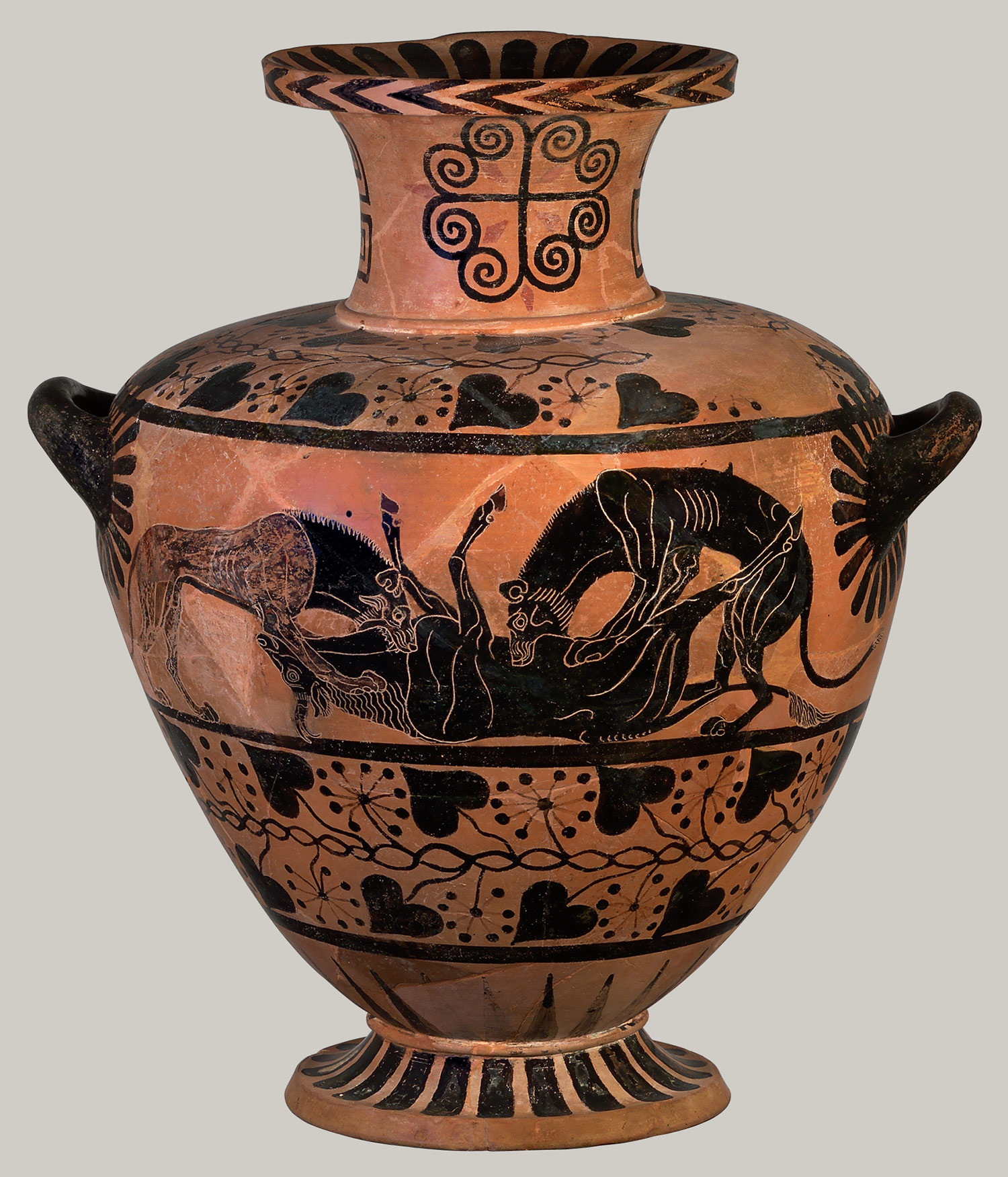
The Terra-cotta Hydria


“The Terracotta Hydria,” or water jar, was crafted ca. 520-510 BCE and is attributed to the “Eagle Painter” (Metropolitan Museum of Art). This black-figure hydria was found in Etruria. Scholars believe the piece was made by East Greek immigrants who settled just north of Rome. The piece is true to its time in that it displays the conventions of the Archaic period. Even though there are no humans depicted, the two felines attacking a bull are rendered more realistically than in the previous Geometric and Orientalizing periods. However, the influences of these periods are still evident in the spiraled and geometric shapes lining the lip and neck of the hydria. In comparison to “The Euphronios Krater,” a red-figure decorated calyx krater crafted ca. 515 BCE, we can detect the same movement away from the generalization of forms in a geometric sense. Stokstad notes that there is more movement and overlapping of figures in Archaic pottery paintings than in previous periods—giving the figures more three dimensionality (119). We have talked in class about the changing conventions in Greek art. In each of these pieces, it is easy to see a sort of evolution of the presentation of forms.

Monday, October 18, 2010


I have been a fan of a significant portion of Marilyn Manson’s musical oeuvre for some time now. Born Brian Warner, Manson took his new name—a combination of Marilyn Monroe and serial killer Charles Manson—when he formed his goth-rock ensemble at the urging of friend Trent Reznor of Nine Inch Nails. However, before his musical career, Marilyn Manson was a self-proclaimed painter and poet. He continued his visual art throughout his fame as a musician. In 2007, he began exhibiting some rather interesting watercolor paintings in various museums.
            Charles Giuliano reviewed a 2009 exhibit from the Volta Art Fair, at first dismissing any attempt at art by the infamous “Anti-Christ Superstar.” However, Giuliano was surprised to find influences of German Expressionism and the same underlying themes of alienation, death, gender, and disaster as are apparent in Manson’s music. It seems Giuliano was intent on placing Manson’s art in the trashcan of celebrity cross-over artists, but instead found a fixated and strong intentionality in the rocker’s work.
Portrait of the murder of the Black Dahlia


Edgar Allan Poe was an influence.


While some of the subject matter and figures are quite , the bright color and brilliant use of the watercolor medium make Marilyn Manson a visual artist in my mind. Furthermore, an artist is someone who has a clear vision of his or her obsessions. Manson represents those who feel uncomfortable in their own skin, those on the fringes of society struggling not to fall off. In comparison to the idealization of the human form in Greek art, Marilyn Manson seeks the dark recesses of the human condition. The Greeks feared chaos and thus created order in their art while Manson’s self-proclaimed “Anti-Christ Superstar” persona represents his antagonism to organized religion and conventional expected behaviors of the individuals in a society. He accepts the inherent chaos of living and perhaps keeps a minimal order in his life by putting that chaos out into the world. 

-abundance of images

-Giuliano article

"Peplos" Kore


Several times in class this past week we have looked at the “Peplos” Kore statue from the Acropolis in Athens. This female marble figure dates to about 530 BCE which places her before Periclean Athens. The Peplos Kore’s style, which is less stylized than previous and contemporary statues such as the Metopolitan Korous and the Berlin Kore yet not as realistic as later Greek statues, represents a shift in Greek art. The Peplos Kore’s orientalized hair and stark position evoke a memory of the Egyptian art we have seen this semester. We know that Greek art was considerably influenced by the Persians and vice versa. The Peplos Kore seems to be “in between” styles in the sense that she is approaching the Classical style of Periclean Athens. She retains the “Archaic smile” which we have discussed in class, but later we begin to see more naturalistic human emotion on the faces of Greek statues in the Classical period. 

Friday, October 8, 2010

Downtown Presbyterian Revisited (in spirit)


 Downtown Presbyterian first seemed out of place, nestled between close buildings and a bustling street. However, I noticed that the area is a sort of architectural hodge-podge, full of classical, modern, and other styles. But seeing the church from the inside, to me, rendered the site of the building unimportant. The red carpet gives off a warm light while the stained-glass windows' blue tint is cooler. It gave me a sense of being warm and welcome inside while the outside may be a bit less comforting or chilly. 
The decorative painting and bright colors seemed oddly obnoxious at first. When I think of ancient Egypt, I think of how the monuments look now--tan and sandy. So the church initially seemed to overdo this Egyptian theme until I realized that this style of painting and color use is probably close in nature if not accurate to what we might have seen in Egypt's glory days. 


(I've just tried here to touch on anything I might not have mentioned in my first post.)

Saturday, September 25, 2010

Downtown Presbyterian


My first impression of the Downtown Presbyterian Church was how large the sanctuary appears to be. The tall painted windows, tall doors, and rhythmic columns give a sense of grandeur and importance. However, the room itself is not all that large. Also the hypostyle trompe l'oeil paintings accentuate this effect. Our group agreed that the style of architecture gave this impression of vastness and importance. While I thought the sanctuary was beautiful, it did seem a little bit out of place in a downtown church in Nashville. We briefly discussed the implications of paganism and other conflicting religious views that may be inherent in incorporating such distinct architecture. I would love to discuss this further to understand more what the population of Nashville during the church’s construction felt about the architectural choices made. 

Thursday, September 16, 2010

Tokyo Up, Down


          Xavier Comas’s black and white photography series, Tokyo Up, Down, seeks to explore the “basic paradox of personal alienation in urban living: the inescapable physical proximity countered by emotional distance” (Comas). His series, available in the online version of Lens Culture: Photography and Shared Territories, captures the strangers of Tokyo’s upscale business skyscrapers as well as those in the Red Light District as they take their short rides up and down in the elevators. Comas looks for the “subtle interactions between strangers on the shortest ever journey” (Comas). Some of his images are composites, showing a lonely figure against the sharp Tokyo metropolis. Others bring to life that uncomfortable, too close feeling we can get in a crowded elevator or dark building. Visually, the images are strikingly contrasted and eloquently composed—despite their voyeuristic style. 

Lens Culture link

Palette of Narmer

    I have always been fascinated with ancient Egyptian art and culture. For a long time, my sister and I were plotting to move to Egypt to belly dance. Then we realized we would have to gain fifty pounds for our bellies to be worthy enough spectacles. Reality has set in, but ancient Egypt is still a place of awe and inspiration for me.
   In class, we looked at the exquisite carvings of the Palette of Narmer. This artifact reveals so much about Egyptian art conventions, culture, and writing style. King Narmer, with the use of hieratic scale, is portrayed larger than his enemies. The enemy, who is about to be bashed over the head with a club, is inferior to Narmer’s larger frame. The palette also uses phonetic symbols to represent the King’s name.
   However, what is most interesting to me is the symbolic portrayal of the unification of Upper and Lower Egypt with the twisting of two elongated lion heads on the opposite side of the palette. Although this palette is thought to be an extraordinary version of an ordinary object and was probably never used, the twisted lion heads make up the round area where pigment would normally be ground into eye shadow. The image of ancient Egyptian men and women alike wearing eye makeup has always seems like an eccentricity until we discussed the need for such make up (protection from the elements). However, even knowing this, it is hard for me to understand why such an important event as the unification of Egypt would be carved onto the form of a makeup palette. Any theories? 

Thursday, September 9, 2010

splIt


I began with a stack of images from magazines that I had ripped out in hopes that I would be able to use them at some point—either as references or subject matter. Obviously, we all know I adore surrealism by now. I had this flyer from the Frist’s “Surreal to Reel: Paris on Film” expo which I cut up, using the title and two different sized images from Un Chien Andalou. I picked out drawings, contact sheets, and strips of film that all related somehow to this vision. There is a separation between snow-covered mountains to the left and a constructed city to the right with a figure in between. One of the biggest decisions I have to make within the next year and a half is whether to go to New York or out West to Utah or California for film school, so this division represents that decision (as well as that looming battle between people and the earth).

Decisions: Because what I chose to include is visible, I will say that I had to reluctantly exclude some elements that were too literal and didn’t fit with my theme (for example I omitted an image of a snowboarder in the mountains, letting the mountains themselves be representative of my favorite pastime and place).

Color: Blue and red, I have realized, are my “go to” colors. Even if I do not plan to use them, I somehow reach for that cadmium and Prussian—bold and calming.

Light: I tried (only somewhat successfully) to create a gradient from dark to light to evoke a sense of perspective. In the future, I’ll know that poster board and acrylic is rather sticky.

Texture: Because I used cutouts from different snowboard magazines for the mountains, I went through with paint and a sharpie to try to unify the textures without covering the images completely.

Volume: The two figures from my sketchbook at the top left seemed flat so I went in with a medium blue to shape them a little more.

Line: I used contour lines on the mountains and tried to arrange the figures so that their gazes would mostly lead to the figure in the center, creating a sort of x axis when implied lines.

Space: The city and the gradient probably provide the best sense of perspective in the composition. The buildings are larger in the foreground.

Scale: A “cameo,” if you will, of my mom is in the bottom left corner. The original drawing was much too large for the board, but kept her relatively big and in the foreground to represent her importance.

Symbolism: I think I could pull out a lot of symbols from this, but I will go for the main ones: 1. The entire piece represents an important decision. 2. The brain in the bottom right corner is a symbol for the importance of knowledge. 3. The mountains represent peace and retreat for me. 4. The two nuclear power plant towers in the distance represent my childhood and home on the Tennessee River (When I was young my mom would tell me that the Sequoia towers were there to make clouds).

Subject Matter

Me: I’ll try not to be redundant and just point to things I haven’t addressed yet. The toilet above the brain represents my love for potty humor. Farts are funny. I love the geometric aesthetic of staircases so I through a red one in there (double bonus). Also, I love cheesy horror films—I did a murder mystery series for photo class a few semesters back and included some of those contacts at the top of the right building.

Friends and Family: If you look closely at the cityscape, there is a little blond cherub boy popping out—that’s my then 2yr. old nephew, Walker. The bottom left corner is home to my mom and the hand of my best friend from high school, Amy. Also, my family usually goes out West over Christmas to ski and snowboard so the mountains make me think of my family. My brother and I used to want to be storm chasers because we love lightning so much.

Town, Community, Home: I could see the nuclear towers from my lake house and my high school—both on the Tennessee River. I also used a Shakespeare quote (at the bottom left) that I cut out of a program from a Belmont play. As for my home and community, those are a little bit in flux these days.

My country: This is honestly not something I thought about while creating this collage, but maybe we are a little bit divided. Perhaps my love for red and blue stem from a deep dormant appreciation for the USA?

The World Today: We are killing the planet and ourselves. We are wasteful and corrupt (chemicals in food and consumer products) and yet still reluctant to listen to the people who are actually trying to better this situation. This is another reason for my division of the mountains and the city. We want to control everything, but there are forces stronger than our own.

Art: I like to believe that art has a greater purpose than what I am about to say. But honestly, I love art because it entertains me, pacifies me, lets me escape from the hum drum of everyday life. I don’t particularly enjoy talking about art in terms of what it means. This is a depiction of a world I would like to step into and see what kinds of bizarre characters I may meet.

History: Everything in my life—my interests, experiences, and genes—has led me to who I am now. Most of the elements I have included are things I have experienced or loved in the past as well as hope to experience and love in the future.

Thursday, September 2, 2010

“Film, Freud, and Paranoia: Dalí and the Representation of Male Desire in An Andalusian Dog”


Ignacio Javier López’s article “Film, Freud, and Paranoia: Dalí and the Representation of Male Desire in An Andalusian Dog” has a three tiered thesis: First, López argues that Dalí and Luis Buñuel’s 1926 film, An Andalusian Dog, exemplifies the “aesthetic theories of Surrealism” that compliment “the Freudian notion of persistence of desire (37). Secondly, that the motion picture, above all other media, was the “ideal form to portray sexuality” because it was free of the attached meanings and cultural boundaries of other traditional art media (38). Finally, López argues that Dalí’s work, including An Andalusian Dog and numerous paintings, deals largely with his fear of sexually transmitted diseases and the loss of self-sufficient sexual independence. I viewed An Andalusian Dog just prior to reading this article. The film’s symbolic and disturbing images made little sense to me before applying López’s thorough analysis (the two authors rejected all images that could be explained rationally). Each character and image is explained in terms of Dalí’s view of sexual repression and loss of self as a result of succumbing to desire. I chose this article because I am interested in the pairing of Freud’s psychoanalytic theory and the Surrealist movement, and of course film. I was unsure of how this subject might relate to our class, but I noticed that López often mentioned the film’s relationship to the culture in which it was created. Buñuel and Dalí, although both from Spain, decided to premiere the film in Paris, where they felt there was an audience more open to questions of identity and convention in society. In terms of material culture study, An Andalusian Dog has plenty to say about its contemporary society and the reactions against it, the negativity toward homosexual relationships or sexual exploration. In addition, studying this short film and López’s analysis has explained many themes in Dalí’s paintings that were otherwise unidentifiable for me. Considering An Andalusian Dog is a moving image, I have posted the famous film still and cover of the woman who is about to have her eye split with a razor (sure makes you want to watch it, right?) López makes a comprehensive and compelling argument concerning the relationship between Freud’s writings and the Surrealist movement, the symbolism and narrative of An Andalusian Dog, and finally the underlying theme of male sexuality in the film.
Link to full film on Youtube.com 
Link to article on Project Muse


The images we have discussed thus far in class have all contained examples of the elements of form that Horowitz discusses in “Reading Paintings.” Because googling “Jesus on the cross” was a disaster and needless to say unsuccessful, I will study and describe the painting and see if I can gain any insight as to when and by whom it was made.

The oil painting approaches photo-realism in its style yet is arranged theatrically. The diagonal line of the illuminated Jesus creates a dynamic focal point. The pyramidal upward motion of the composition not only implies movement and struggle, but as we discussed with the painting of the Madonna and Child, the pyramid was considered a perfect shape—representing the holy trinity. Although Jesus is being crucified, oppressed, executed, he remains above those who are persecuting him. He is thrust into the light while the other men remain mostly in his shadow.


Undoubtedly, in its time, this painting was an expression of the strength of Christ. If I had to make an uneducated guess (this is my first course in art history), I would think that this painting was done before the Enlightenment by someone painting in the academic or classical style. By the content and perspective (Christ literally held up), the artist and the painting’s intended audience were reverent and Religious people, empowered by the master narrative of Christianity

Tuesday, August 31, 2010

Little Ashes

Paul Morrison's 2009 film Little Ashes, follows Salvador Dalí (Robert Pattinson), poet Federico García Lorca (Javier Beltran), and filmmaker Luis Buñuel (Mathew McNulty) through their years at the Resedencía de Estudiantes in Madrid, focusing on the intimate relationship between Dalí and Lorca up until Lorca's execution by the Spanish fascist regime. I've watched this film twice now. It is based on the true relationship between the painter and poet and is presented in a dramatic and beautiful way. I recommend it! Available for instant viewing on the miracle of Netflix.

Thursday, August 26, 2010

Woman With a Head of Roses by Salvador Dalí


While I understand that paintings are interpretations of reality, I still find it boring to interpret the so-called “real world.” Instead, like Dalí, I try to create a new, bizarre, and often impossible person, place, or thing. Likewise, I wouldn’t surround myself with images of this world, but rather with the infinite atmospheric landscapes of the master of surrealism himself. Salvador Dalí’s “Woman With a Head of Roses” demonstrates all that I adore about the dangerously convincing oddities of surrealism.
            What first grabs my eye is the absurdly tall and slim woman facing me—her hip slid to the left and her bony arms animated. The bold contrast of her five dark and outstretched fingers against the light blue gradient background creates a somewhat central focal point. Her form’s organic slope draws attention to the fine detail in her emerald gold dress and the exposed and somewhat suggestive red-stocking leg. Mysterious white hands embrace the woman’s stomach and arm. One points to a lone egg on a silver table. Why? Does anyone know? That’s beside the point. I then see the lion head in the distance—the base of a pointy rock garden and the focal point of an indistinct man in the distance. There, I follow the lines of the seemingly wooden floor back into the foreground. The serene horizontal horizon seems quite far away due to the small scale of the man and the angle of the cracks in the floor. Another woman, in a sparkling red dress reads a piece of paper, her hand holding back her hair or holding her face in despair, surprise, disappointment. Nothing is certain.
            I am attracted mostly to Dalí’s use of hard light and sharp, stretching shadows to make these abnormal beings seem so realistic. The texture is so clean that his paintings become desolate, the figures often solitary in the midst of a nightmarishly empty world. His arrangement of strange objects and breadth of imagination keep me interested much longer than any realistic painting does. I entertain theories about the relationships between the women and the man, why the woman has a head of roses, and does the egg symbolize fertility or pregnancy? But most of all, this painting is full of beautiful design. I actually came across a website that actually sells these two pieces of furniture (I cannot seem to find it again, but I will post it once I do). And according to art.com, Dalí played a part on the fashion and photography scenes as well. “Woman With a Head of Roses” surely exemplifies his sense of fashion, sculpture, perspective, and most importantly, his desire to question reality by creating a new one. I would say this Dalí piece is my favorite right now (it simply struck my fancy for all the reasons explained above), but next week it will be different... “The Temptation of St. Anthony” maybe.

“Surrealism is destructive, but it destroys only what it considers to be shackles limiting our vision.”    -Salvador Dalí