 |
| The Euphronias Krater |
 |
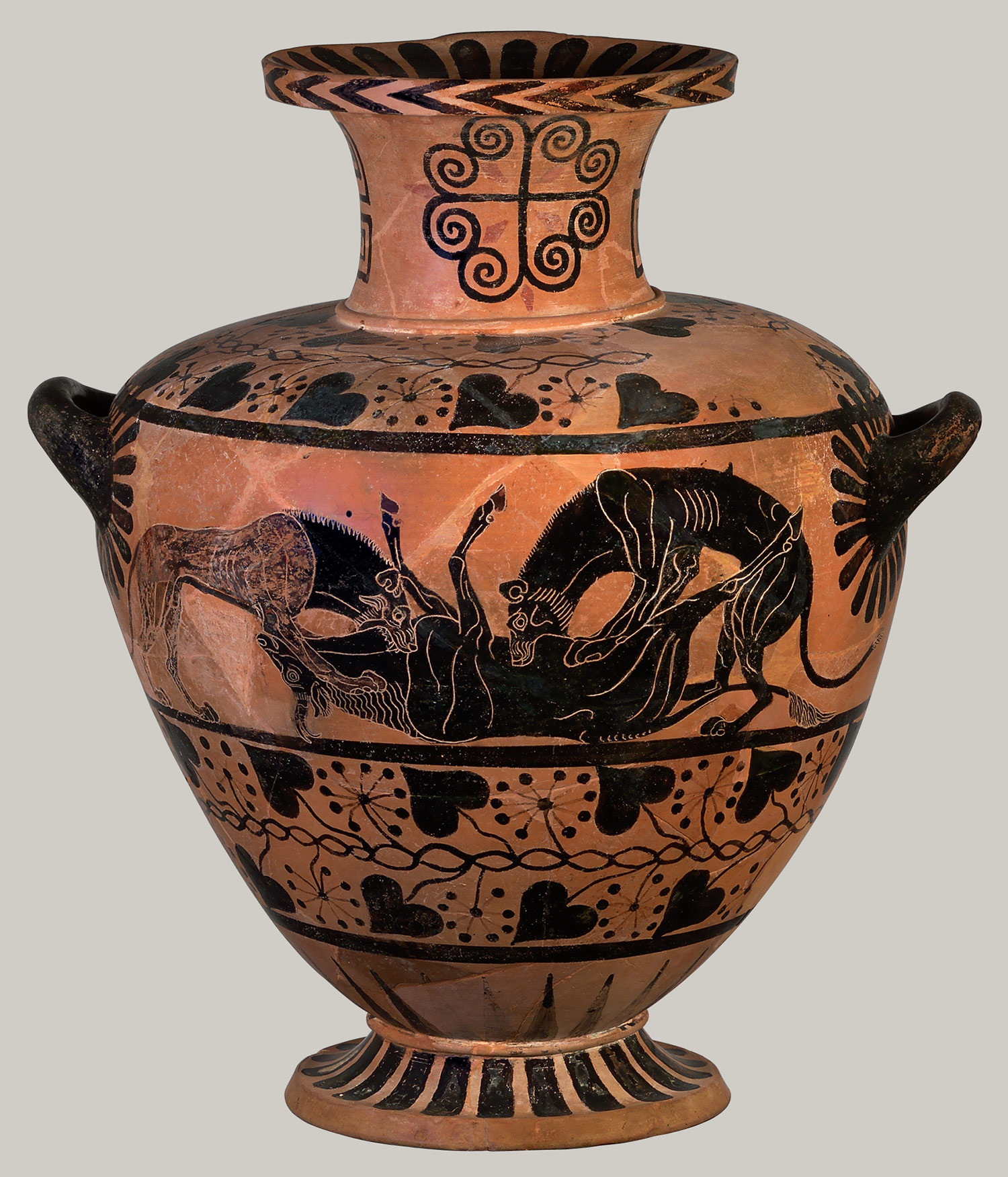
| The Terra-cotta Hydria |
“The Terracotta Hydria,” or water jar, was crafted ca. 520-510 BCE and is attributed to the “Eagle Painter” (Metropolitan Museum of Art). This black-figure hydria was found in Etruria. Scholars believe the piece was made by East Greek immigrants who settled just north of Rome. The piece is true to its time in that it displays the conventions of the Archaic period. Even though there are no humans depicted, the two felines attacking a bull are rendered more realistically than in the previous Geometric and Orientalizing periods. However, the influences of these periods are still evident in the spiraled and geometric shapes lining the lip and neck of the hydria. In comparison to “The Euphronios Krater,” a red-figure decorated calyx krater crafted ca. 515 BCE, we can detect the same movement away from the generalization of forms in a geometric sense. Stokstad notes that there is more movement and overlapping of figures in Archaic pottery paintings than in previous periods—giving the figures more three dimensionality (119). We have talked in class about the changing conventions in Greek art. In each of these pieces, it is easy to see a sort of evolution of the presentation of forms.

No comments:
Post a Comment